One policy plane for a company that answers to many laws
Multinationals do not get one AI regulator. They get all of them at once: the EU, the US state patchwork, China, the UK, Singapore, and more, each writing different rules for the same technology. This part of the series is about the architecture that lets one company run agents everywhere it operates: regional gateways, regionally approved models, and local-law policy overlays, all under a single global policy and identity plane.

The first two parts of this series looked at single industries: manufacturing and insurance. This one looks at a dimension that cuts across every industry: geography. Because the moment a company operates in more than one jurisdiction, its AI program stops being one program. It becomes several programs wearing the same badge, each answering to a different set of laws, and each drifting away from the others unless something structural holds them together.
1 · The problem: one company, many rulebooks
AI regulation is not converging into a single global standard. It is converging into a family of standards that rhyme but do not match.
European Union
The EU AI Act imposes risk-tiered obligations: logging, transparency, human oversight, and data governance, with reach into any system serving EU users. GDPR sits underneath it, governing what personal data may feed a model at all.
China
PIPL localizes personal data. The generative AI measures regulate what models may be offered and how content is handled. In practice, Western frontier models are unavailable, and in-country models are the working option for local teams.
United States
No single federal AI law; instead a growing patchwork of state statutes, sector rules, and FTC enforcement positions. What is permitted in one state may carry disclosure or testing obligations in another.
UK & Asia-Pacific
The FCA reaches algorithmic decisions affecting customer outcomes. Singapore's MAS publishes fairness and explainability expectations. Data-residency requirements appear across the Gulf, India, and Southeast Asia in sector-specific forms.
Each regime is manageable on its own. The failure mode is what happens when a company handles them separately: a different AI stack per region, a different policy per stack, and no way to state, let alone prove, what the company's AI is doing globally.
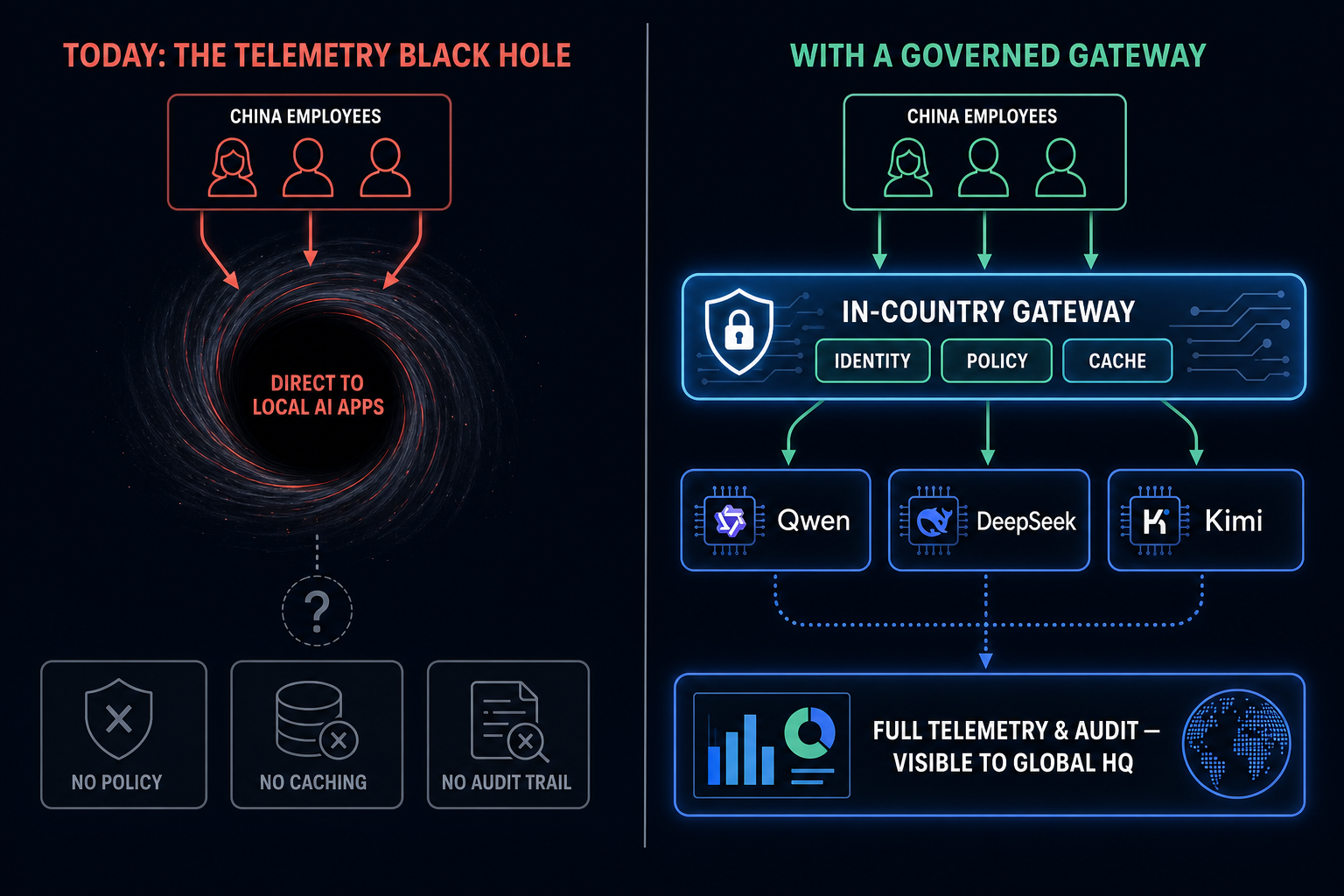
The sharpest version of the problem is the region where the global stack simply does not reach. A multinational's teams in China cannot use the frontier models the rest of the company runs on, so they use capable in-country alternatives. That usage then happens entirely outside the company's governance perimeter: no policy enforcement, no caching, no telemetry, no audit trail. From headquarters it is a black hole. Traffic goes in, and nothing comes back.
2 · Why the usual fixes fail
Three approaches get tried, and all three fail structurally.
- The global mandate. "Everyone uses the corporate stack." Regions where the corporate stack is unavailable or unlawful ignore the mandate, because the alternative is not doing their jobs. Shadow AI fills the gap, invisibly.
- The regional fork. Each region builds its own AI platform to local requirements. Policy is now defined in four places by four teams in four formats. The definitions drift immediately, and no one can answer a board-level question about global AI posture without a spreadsheet exercise.
- The per-vendor patchwork. Each platform's own governance features get configured per region. Every vendor console has its own policy model, none of them sync, and an auditor gets a different story from each. Nobody has anything complete.
Policy that lives inside each application is policy that forks. Policy that lives in the layer every application passes through is policy that holds.
3 · The architecture: regional gateways under one global plane
The structural answer mirrors how multinationals already run networks and identity: local presence, central control.
A governed gateway deploys in each region, inside infrastructure that satisfies local law: the company's own facilities or an in-region cloud. Every agent, application, and user in that region reaches AI through the regional gateway. Above all the gateways sits a single global policy and identity plane: one place where policy is defined, one corporate identity source, one audit format, one cost ledger.
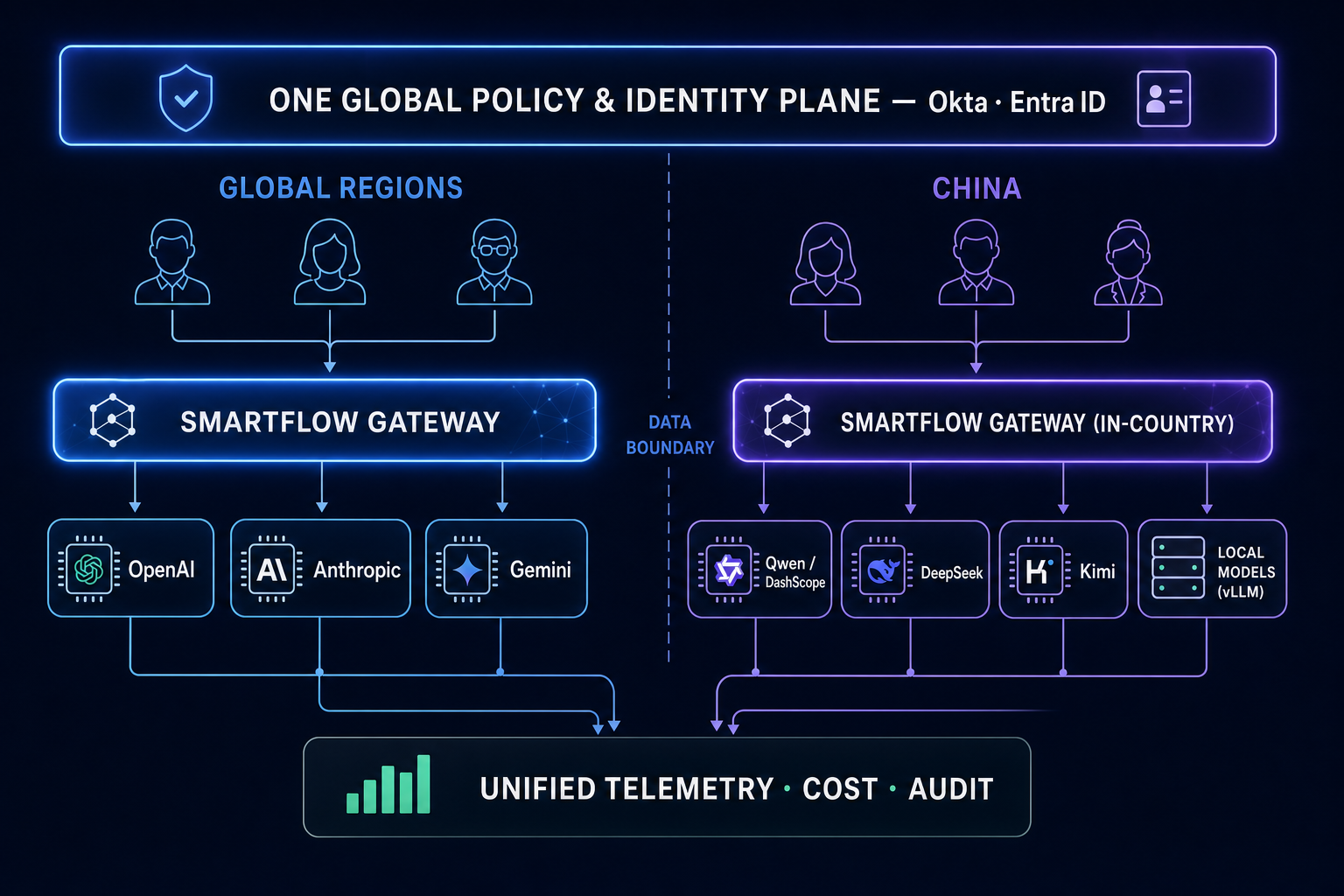
The division of labor is precise:
- Policy is defined once, globally. Data-class rules, guardrails on tool calls, approval requirements for consequential actions, and cost controls are written in one place, as one set of definitions, owned by one function.
- Policy is enforced locally, with regional overlays. Each regional gateway enforces the global baseline plus an overlay expressing local law: which models are approved in this region, what data may leave, what must be redacted, which workflows need in-region human approval. The overlay extends the baseline; it cannot silently weaken it.
- Content stays in region. Prompts, documents, and responses are processed and stored where the law requires. What crosses borders is governance metadata: who used AI, under which policy, at what cost, with what outcome.
- Models are a regional catalog decision. Each region gets a vetted model catalog: frontier models where they are available and lawful, in-country models where they are the working option, and locally served open models inside the perimeter. Routing between them is policy, not application code.
- Identity is global. The same corporate identity provider (Okta, Entra ID, or an in-region equivalent federated to it) authenticates every user and binds every agent to a human principal, everywhere. Group and role claims drive team assignment and policy in every region identically.
4 · Regional policy overlays: alignment to local law as configuration
The overlay mechanism deserves its own section, because it is what turns "we comply with local regulations" from an aspiration into a control.
A regional overlay is a small, reviewable set of policy statements layered onto the global baseline. Examples of what an overlay expresses:
Residency rules
Personal data classes that must not leave the region, enforced by redaction or refusal on the request path, not by trust in application developers.
Approved model sets
The EU overlay might exclude models that cannot meet logging obligations. The China overlay routes to Qwen, DeepSeek, Kimi, or locally served models. The US overlay may differ by state-sensitive workflow.
Oversight thresholds
Which actions require a verified human approval in this jurisdiction, reflecting local requirements for consequential or automated decisions.
Disclosure & retention
Per-region logging depth, retention windows, and disclosure formats, so a local data call is answered from local records in the expected shape.
Because overlays are configuration on one shared policy engine, three things become possible that forked stacks can never do. Legal can read the actual difference between regions as a diff, not a discovery project. A new regulation lands as an overlay change, not a re-platforming. And the global baseline, the floor no region may drop below, is enforced by the same machinery everywhere.
The question this answers
"Show me your company's AI controls in every country you operate in, and prove they were actually applied." With forked regional stacks, that question takes a quarter to answer badly. With one policy plane and regional overlays, it is a report, generated from the same records the enforcement path produced.
5 · What headquarters gets back
Routing every region through a governed gateway does not just satisfy local law. It closes the visibility gap that regional AI created in the first place.
Unified telemetry
Every model call in every region produces the same usage, cost, and audit records. The black-hole region becomes just another region on the dashboard.
Global cost governance
Per-team, per-region, per-workflow cost attribution in one ledger, with caps and routing rules applied consistently. Semantic caching serves repeated traffic locally, which also matters where in-region model capacity is constrained.
One audit story
A single tamper-evident audit format worldwide. Local regulators get local records; the board gets the global picture; both come from the same chain.
The exhaust flywheel, per region
Each region's traffic can distill into small, specialized local models served inside that region's perimeter, cutting cost and latency while keeping data home. Governance stays constant regardless of which model answers.
6 · The operating model
The architecture holds when the organization around it is explicit, and the multinational version adds one rule the single-market version does not need.
Own the baseline centrally, own the overlays regionally
One global function owns the policy baseline and the shared plane. Each region owns its overlay, with local legal and compliance review, inside limits the baseline sets. That split respects the reality that local teams know local law best, without letting local knowledge become global fragmentation.
Publish the regional catalogs
Every region's approved model and tool catalog is published, versioned, and visible. Teams building agents know what they may use where, before they build, and an agent promoted from one region to another is re-validated against the destination overlay as a routine step.
Treat new regulation as an overlay change
When the next AI act lands, the response is a policy review and an overlay update, shipped through the same review process as any other change. That is the difference between a governance program that absorbs regulatory motion and one that is re-architected by it.