One governed agentic layer for the plant floor
How manufacturers can expand capability with AI agents while keeping governance, compliance, and a clear operating model intact. This is not a list of use cases. It is the architecture that makes the plant floor safe for autonomy.

Every manufacturer is hearing the same advice right now: put agents to work. Let them read the historian, reconcile the MES against the ERP, draft the changeover plan, triage the quality escape, brief the maintenance tech, negotiate with a supplier's system. The capability upside is real and it is large.
The plant floor is also the hardest place on earth to deploy ungoverned AI.
A chatbot that hallucinates in a marketing tool is an embarrassment. An agent that issues the wrong tools/call against a line controller is a safety event. What separates those two outcomes is the architecture around the model, not the model itself. This article is about that architecture: the conditions that make manufacturing so unforgiving, and the layered, trust-secured design that lets you deploy agents anyway.
The piece is deliberately product-agnostic. The patterns matter more than any vendor. We build toward these patterns ourselves, and there is a short note about that at the end.
1 · Why the manufacturing environment breaks naïve AI
Before you can secure agents on the plant floor, you have to respect what makes it different from a SaaS back office.
Physical consequence
In IT the worst case is data loss. In OT a bad action moves a robot, changes a setpoint, or halts a line. Consequence must be a first-class input to every decision.
Protocol zoo
OPC-UA, Modbus, MQTT, PROFINET, plus MES, historian, ERP, and quality systems. Some are real-time, some decades old, few built for modern auth. Agents can't speak to these directly and ad hoc.
Edge & sovereignty
Much data can't leave the plant; some can't leave the cell. Governance has to hold at the edge with deterministic latency, not only in a distant cloud.
Non-repudiation
Regulated manufacturing lives on traceability. If an agent participated in an action, you must be able to prove to an auditor exactly what it did and under whose authority.
Wide least-privilege surface
The surface is not just agents. It is agents plus data sources plus robotics plus the tools partner vendors reach in with. Every one is a potential over-privileged path.
The fragmentation trap
One-off integrations win by default: a point connection here, a script there, a vendor tunnel elsewhere. Together they neither scale nor govern.
You cannot govern what you cannot funnel. If there are twelve ways for an agent to reach a machine, you have zero enforceable controls.
2 · The architectural answer: one ubiquitous, governed agentic layer
The solution is not another point tool. It is a single, ubiquitous middleware layer that every agent, data source, robot, and partner tool connects through: a common agentic layer, secured by a trust layer, serving AI across the plant or the whole organization.
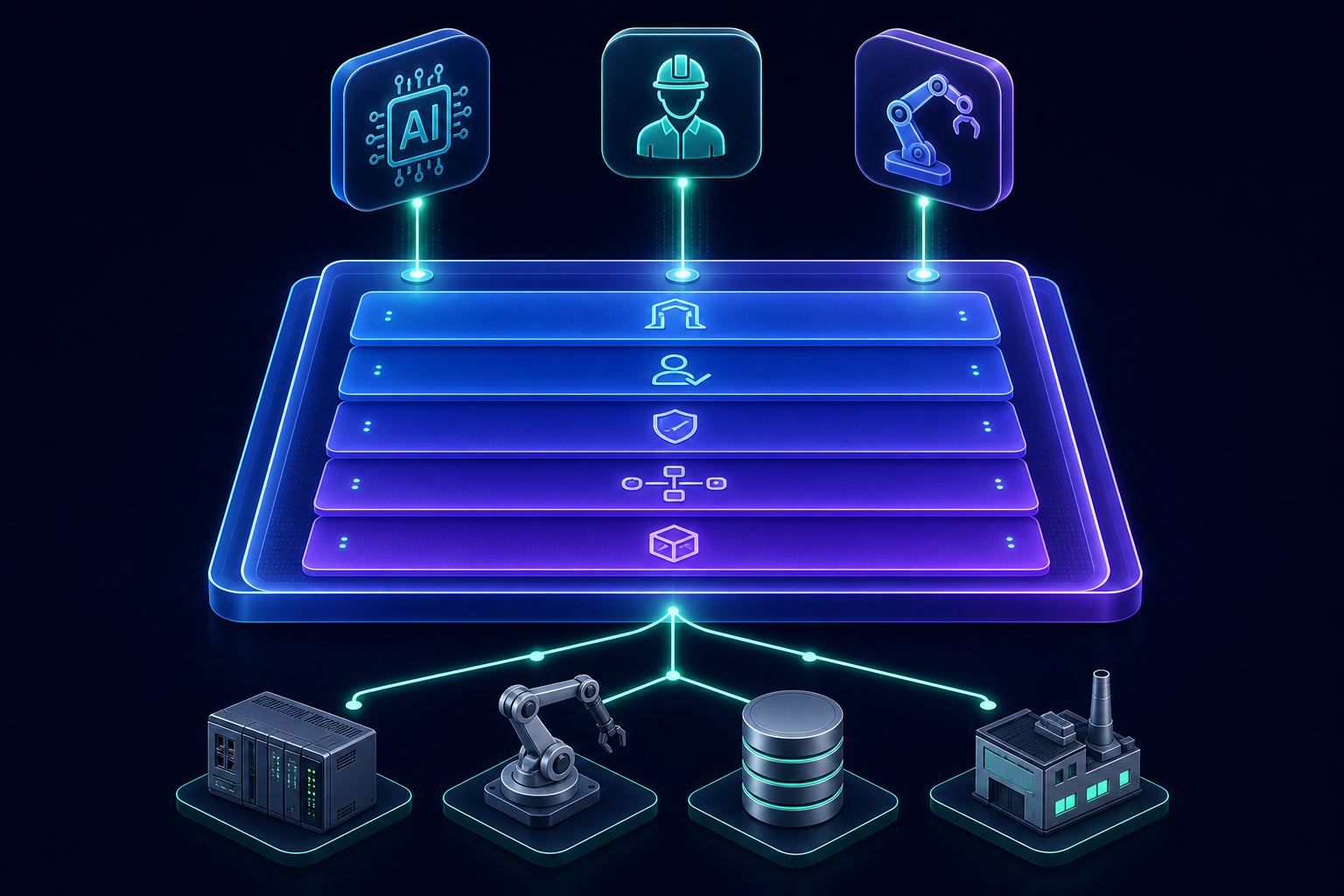
Think of it as the plant's agentic operating system: a middleware layer that carries workflow orchestration and the governance components needed to safely unlock agents. Its layers:
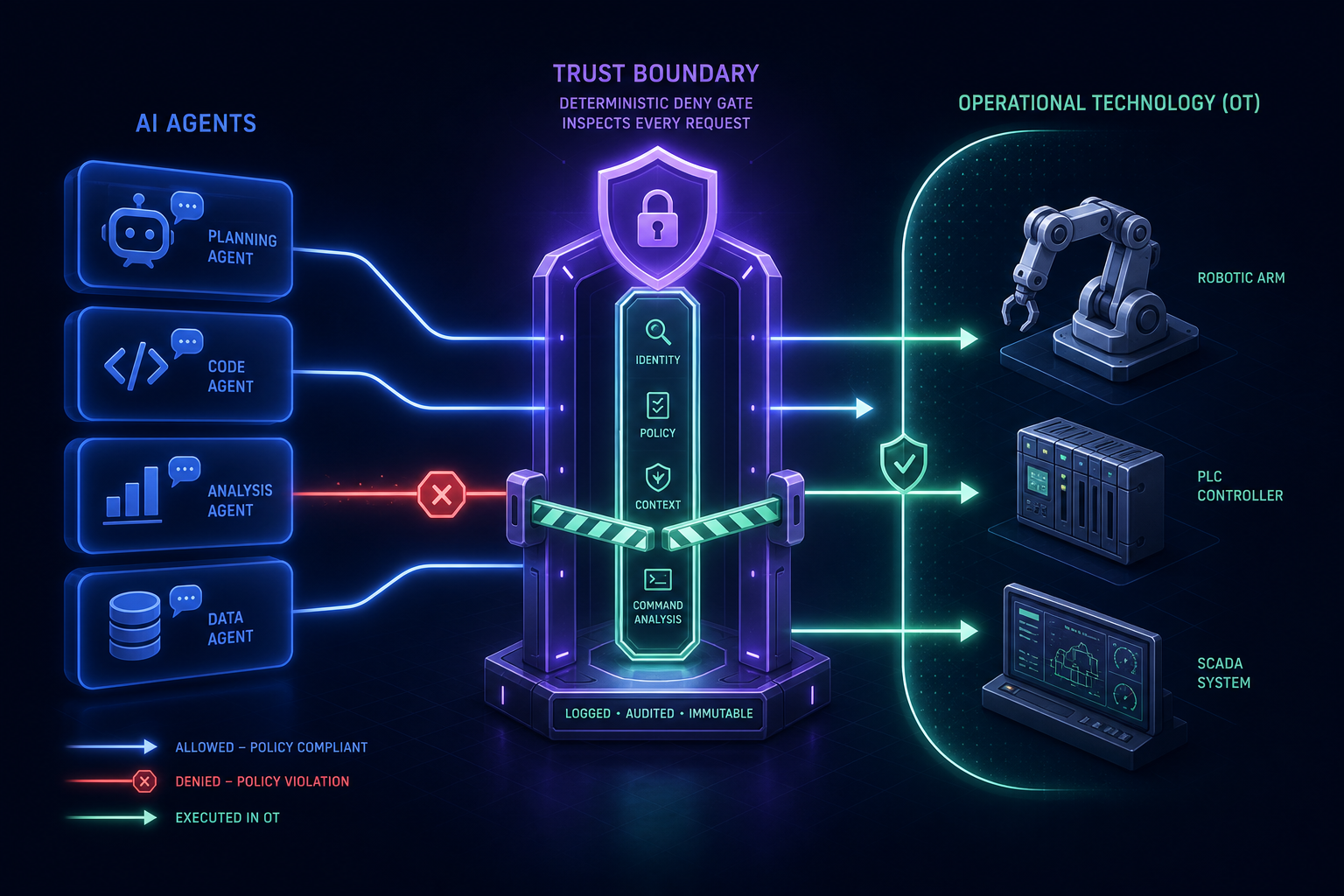
- Trust & access gateway. A single governed path with a deterministic deny. If a request isn't explicitly allowed, it doesn't happen. No side doors.
- Identity. Every agent's identity is bound to a human principal, and high-consequence actions require a verified human in the loop.
- Policy & guardrails. Fail-closed and least-privilege, enforced at runtime on the request path rather than described in a wiki and audited after the fact.
- Workflow orchestration. Multi-step, multi-agent (A2A) coordination with holds, approvals, and rollback built in.
- Published secure capability catalog. A vetted set of tools and data sources agents may use, instead of raw, unmediated access to machines.
- Evidence. A tamper-evident audit chain, so every decision is provable later.
The single most important architectural distinction is runtime enforcement versus after-the-fact logging. Logging tells you what already went wrong. Enforcement stops it at the moment the agent acts. On a plant floor, "we found the bad command in the logs this morning" is not a control. It is an incident report.
Ubiquity matters too. If the governed layer only covers some agents, engineers route around it for the rest, and you are back to fragmented integrations. The layer earns its governance by being the easiest way, and ideally the only way, to get anything done.
3 · The compounding advantage: a layer that learns your plant
There is a benefit that only this architecture can deliver. Because every model call, tool invocation, decision, and human approval flows through the one governed layer, the layer captures something no point integration ever sees: the complete exhaust of all AI activity in the plant. The prompts, the context, the outcomes, and the corrections a verified human made. That exhaust is the highest-quality training data you will ever own about your own operation.
A well-designed layer puts that exhaust to work automatically. It distills the repetitive, well-understood traffic into small, specialized local models tuned to your specific processes, equipment, terminology, and decisions. Large frontier models still handle the novel, hard reasoning. The high-volume, familiar work gets routed to a small model that has effectively been trained on your plant, by your plant: classifying a quality escape, drafting a standard work order, summarizing a shift, answering "what does fault code 42 mean on line 3."
Dramatically cheaper
Routine plant work is repetitive. Serving it from a small tuned model instead of a frontier model cuts the per-call cost by orders of magnitude, and most plant traffic is routine.
Much faster
A small, specialized model tuned to a narrow task responds far faster than a large general model. That matters in an environment that demands deterministic, low-latency answers at the edge.
Secure by locality
These models run locally, at the edge, inside your perimeter. Sensitive process data never has to leave the plant to get a useful answer.
Learns only your use case
The model improves from your traffic and no one else's. No generic internet noise, no cross-tenant leakage. It gets measurably better at your operation over time.
The advantage compounds. The more the plant uses the governed layer, the better and cheaper its local models become, which drives more usage through the layer. Governance and economics reinforce each other instead of fighting. And none of it weakens the controls: the same gateway, identity binding, policy enforcement, and audit chain apply whether a request is served by a frontier model or a home-grown mini-model.
The layer you route everything through for governance is the same layer that can quietly learn your plant, turning the cost of oversight into a durable, private capability advantage.
4 · Building agents safely: an SDK and a common UI over a published catalog
A trust layer that is painful to build on will be bypassed. So the second half of the architecture is a build model that makes the safe path the fast path.
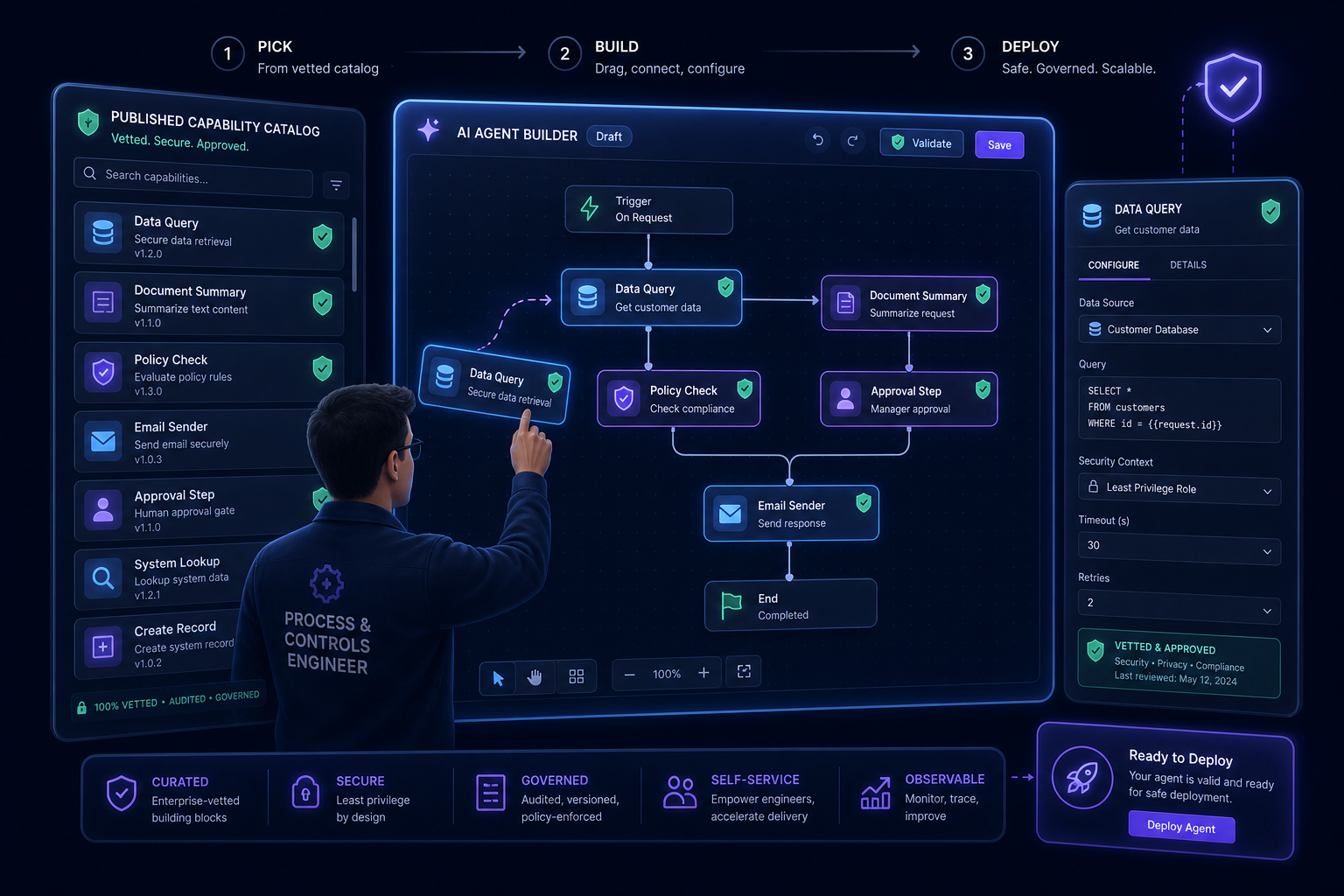
An SDK for the middleware layer
Platform and controls teams publish capabilities: a validated "read the historian for line 3," a policy-wrapped "create a work order." Each one is vetted, versioned, and least-privileged before it ever reaches an agent. The hard security work is done once.
A common UI to assemble agents
Process and controls engineers, the people who actually understand the plant, build agents by composing capabilities from the secure published list in a drag-and-connect builder. They never touch raw robot or PLC access.
This inverts the usual risk equation. In the ad-hoc world, every new agent means a new security review and a new integration risk. In the catalog world, the dangerous surface is curated once by the people qualified to curate it, then safely self-served by everyone else. Capability expands without expanding risk alongside it.
Self-service without a catalog is chaos. A catalog without self-service is a bottleneck. You need both: curated by the few, composed by the many.
5 · Human identity in the loop
For the plant floor, this is the linchpin, and it is where most "AI governance" stops short.
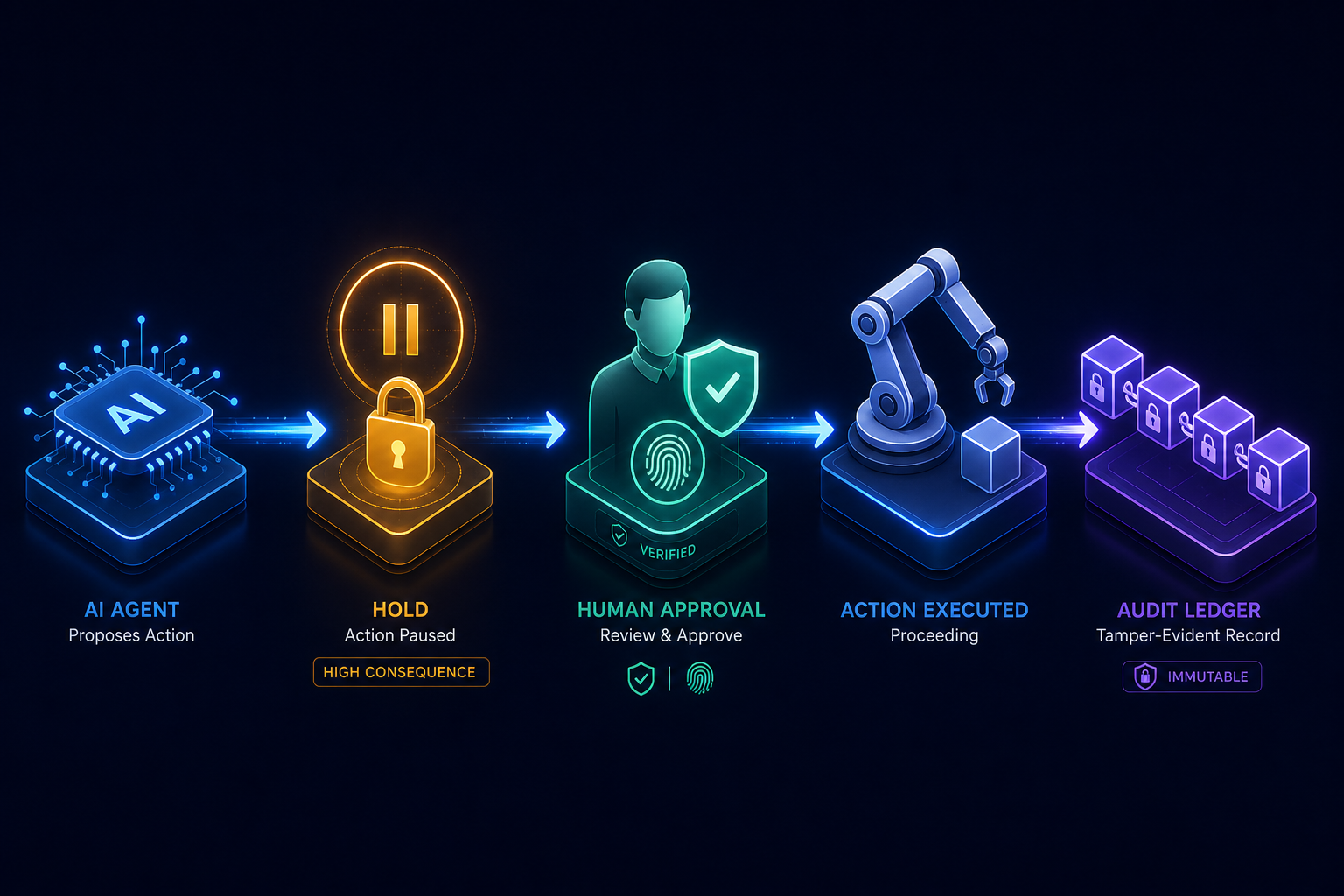
Two ideas have to be true at once:
- Agent identity is bound to a human principal. An agent doesn't act as an anonymous service account. It acts on behalf of a specific, known person, and that binding travels with every request into the audit chain. "The agent did it" is never an acceptable answer. "The agent did it on behalf of this named, verified engineer under this authority" is.
- Consequence-level approval holds high-impact actions until a verified human approves. Low-consequence reads flow freely. When an agent proposes something that moves the physical world or crosses a compliance line, the action is held (not merely logged) until a verified human explicitly approves it. Verification means real assurance of who is approving, through identity proofing and step-up, rather than a shared button anyone could press.
The pattern that makes agentic AI defensible
Autonomy scales with safety. Routine, reversible work runs at machine speed. Irreversible, safety-critical, or regulated work pauses for a human whose identity is provable. Hold the consequential action until a verified human approves, and seal the approval into the record. That single pattern is what makes agents defensible on a plant floor.
6 · The operating model: governance, compliance, and ownership
Architecture without an operating model is a demo. To run this in production across a plant, or a network of plants, three things have to be explicit.
Clear ownership
Someone owns the trust layer as a product: the gateway, the policies, the catalog. Someone owns capability-publishing standards. Someone owns the human-approval queues and the identity binding. Diffuse ownership is how "temporary" ungoverned paths become permanent.
Compliance mapped to the controls, not bolted on
A runtime-enforced, evidence-producing architecture maps cleanly onto the frameworks manufacturers already answer to:
| Framework | What it expects | What the layer provides |
|---|---|---|
| ISA/IEC 62443 | Zones, conduits, least-privilege access to OT | The gateway is the conduit; the catalog enforces least privilege |
| NIST AI RMF | Govern, Map, Measure, Manage AI risk | Policy + evidence make risk measurable and managed at runtime |
| EU AI Act | Human oversight, logging, risk management for high-risk systems | Human-in-the-loop holds + tamper-evident audit chain |
A repeatable model, not a pilot graveyard
Most manufacturing AI stalls at "successful pilot" because every pilot is bespoke and none can be governed at scale. A common agentic layer flips this. The first agent is hard, because you build the layer. Every subsequent agent is a composition problem, not a security project. That is what turns AI from a series of experiments into an operating capability.